
Thank you, DWARFLAB!
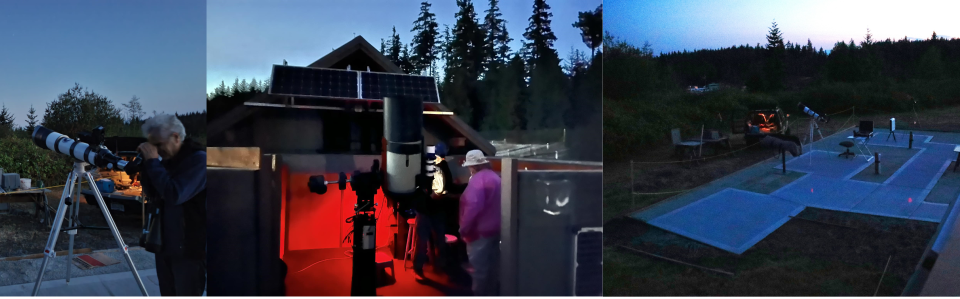
The good people at DWARFLAB have donated a Dwarf Mini to the club! You’ll see it at the observatory and at outreach events through the summer. Several members have already used it and reported the quality of the images, the ease of use, and the fun to be had with customizing the settings (they even have star spikes. Lots of different kinds in their post processing menu.) Of course the Mini is super portable. It’s so small you can tuck it into a purse or coat pocket but don’t be fooled by its size. It may be small, but it is mighty. Here are a couple of images folks have captured with the Dwarf.

This was Laurelai’s First Light with the Mini. She only had 30 minutes before the observatory shut down due to a drop in temperature. Only 83 frames and just look at those dust lanes, the clarity of the stars and yes, star spikes.

Richard Bolt’s stunning North America Nebula taken with the Dwarf.
New Solar Panels
We’d like to give a big shout out to the Sunshine Coast Community Solar Association (SCCSA) for their assistance and generosity in updating the solar power system for our observatory. They volunteered their time to remove the old roof solar panels, install new high efficiency solar panels and new regulation equipment and didn’t charge us a thing! You guys are awesome!


First Light for our New Celestron Telescope Mount

Last night we took our new Celestron CGX-L telescope mount for a test drive. It worked like a charm! The old SynScan mount has been retired after 12 years of service. Thanks again to the Sunshine Coast Foundation for giving us the ability to purchase the new mount.

March 3 Lunar Eclipse
For those of you interested in the March 3 lunar eclipse: The entire event is visible from the Pacific Ocean and western North America. The rest of North America and South America will see part of the eclipse, but the Moon will set before the eclipse ends. The current forecast for us on the Sunshine Coast of BC is not favourable for viewing unfortunately.

Botanical Garden Event

We will be attending this with a slide show on “Flora in the Sky”, featuring clusters, nebulae, and galaxies named for flora down here on earth. No telling what the weather is going to be, but if the skies are clear we will bring telescopes as well.
Training for the “Big Scope”

We’ve just started training new Qualified Operators for our “Big Scope”. If you’re interested, please let us know! It may look a bit intimidating, but its actually quite easy to operate.
Wooden Boat Days 2025

Our astronomers will be at Wooden Boat Days in Madeira Park on Saturday, August 9, 2025, from 10 Am to 3 PM, with our solar scopes.


Canada Day: Hackett Park, Sechelt

Our astronomers and their solar scopes will be observing solar activity at Hackett Park in Sechelt for the District of Sechelt’s Siyaya Days this Canada Day. Come on down to see what the sun is doing.
Maintenance

Its been ten years since we opened the observatory and we’ve been busy lately with maintenance chores, waiting for a clear sky to take care of one critical issue: Realigning the main telescope. We’ve replaced the old handset and tonight (Saturday, 28 June) our team hopes to get this accomplished, so the observatory won’t be open to the public tonight.
UPDATE: 30 June. Chores complete! We are returning to chasing skies to show the universe to the public! Come see us at Canada Day festivities tomorrow in Hackett Park, Sechelt.
Salish Night Skies
This year we are partnering with the Siyaya Reconcilliation society and the District of Sechelt for Siyaya Days. Here is the list of Salish asterisms that Dr. Shandin Pete at the University of British Columbia has recovered in his research for the Royal Astronomical Society of Canada’s World Asterism Project so far. For more information, contact us at sunshinecoast@rasc.ca
Bark Canoe:
This Salish asterism “ƛiyéʔ” is made up of the stars of the IAU constellations Gemini and Orion (Pete 2023). Compare this to the Yolgnu asterism “Boat and Fishline” (see below) and the Chinook asterism “Big Canoe” (see below). One end of the “canoe” is Alpha (α) Orionis (Betelgeuse) and the other end is Beta (β) Orionis (Rigel). The Belt of Orion is the seat across this “canoe”. Five male friends who built the canoe are represented by the stars Gamma (γ) Geminorum, Betelgeuse, Rigel, Gamma (γ) Orionis, Iota (ι) Orionis, and Kappa (κ) Orionis. NOTE: The story describing the creation of this asterism should only be told in the winter month. It is also known as “People Working” (see below).
Camas Baking Pit:
This Salish asterism “SxᵂqᵂÌepm” (“one who cooks things in the ground”) is the IAU constellation Auriga (Pete 2023). The oval of principal stars represents the women cooking camas: Alpha (α) Aurigae (Capella), Epsilon (ε) Aurigae, Eta (η) Aurigae, Zeta (ζ) Aurigae, Iota (ι) Aurigae, Beta (β) Tauri (Elnath), and Theta (θ) Aurigae. The star clusters in the middle of Auriga (and there are several) are the cooking pit. The women fled into the sky to escape Skunk (X̣stéyy̓eʔ). Camas is a plant in the asparagus family.
Cast Away Children:
This Salish asterism “EsɁsḱᵂlelt” is the Hyades cluster and the Pleiades cluster in the IAU constellation Taurus (Pete 2023). Each star represents a character:
- Snč̓le (“Coyote”) is Alpha (α) Tauri (Aldebaran),
- Theta (θ) 1 and 2 Tauri (Hyadum II and III) are a pair of dancing head lice,
- Badger’s wife is Delta (δ) 1 Tauri,
- Badger’s children are Delta (δ) 2 and 3 Tauri and Epsilon (ε) Tauri,
- Coyote’s favorite child is Gamma (γ) Tauri,
- Coyote’s other “cast away” children, the “Crying Children” are the Pleiades cluster.

Crying Children:
This Salish asterism is the Pleiades cluster in the IAU constellation Taurus.
Dog:
This Salish, Chinookan, Lenape, Iroquois, and Meshkwahkihaki star is 80 Ursae Majoris (Alcor) in the IAU constellation Ursa Major (Berezkin 2005).
Grizzly in the Sky:
This Salish star “Smxéẏčṅasqt” is Alpha (α) Ursae Minoris in the IAU constellation Ursa Minor (Pete 2023). This was originally documented in the early 1800’s by Gregory Mengarini SJ.
Hunters:
This Salish, St’at’imc, Nlaka’pamux, Secwépemc, Hul’qumi’num, Snohomish, Schi̲tsu’umsh and Chinookan asterism is the stars of the Big Dipper asterism in the IAU constellation Ursa Major (Berezkin 2005). The three stars of the “handle” are the hunters, and the four stars of the “dipper” are the animal being pursued.
This Salish, Chinookan, Lenape, Iroquois, and Meshkwahkihaki asterism is the stars of the Big Dipper asterism in the IAU constellation Ursa Major (Berezkin 2005). The three stars of the “handle” are the hunters, and the four stars of the “dipper” are the animal being pursued and the star Alcor is their hunting dog (see Dog, below).
People Working:
This Salish asterism EsɁsḱᵂúɁuÌms (“people working”) also known as ƛiyéɁ (“bark canoe”- see above) is the IAU constellation Orion (Pete 2023). The story tells of who were sent into the sky by Blue Jay (Stellers Jay – Qʷásqʷiʔ) to protect them from Storm who sought to drown them:
- The three stars of the belt of Orion asterism are the canoe.
- Alpha (α) Orionis (Betelgeuse), Gamma (γ) Orionis, Kappa (κ) Orionis, Beta (β) Orionis (Rigel), and the sword of Orion asterism are the five young men.
Seven Stars:
This Salish asterism “ČsṕeɁľčs Kʷkʷusm” may be either the IAU constellation Ursa Major or Ursa Minor (Pete 2023). It was documented in the early 1800s by Schaeffer.
As I mentioned in our phone conversation this morning, I can turn this into a handout for Siyaya Days, or you can use it in some form.
Our Centre has three videos on YouTube which are related to this subject:
Salish Skies: https://www.youtube.com/watch?v=WcGPvz4iYlA Dr. Shandin Pete, Assistant Professor of Teaching; University of British Columbia; Earth, Ocean, and Atmospheric Sciences presents an overview of continuing work toward reconstructing Salish asterisms using ethnographic evidence from Salish-speaking communities across the Northwest. Drawing from documented ethnographies of the Salish (Montana), Schi̲tsu’umsh (Idaho), Nlakaʼpamux (British Columbia), Qlispel (Washington), and Syilx (British Columbia), this research highlights connected narratives surrounding three key asterisms: “the canoe” (part of Orion), “Cast away Children” (Pleiades and surrounding stars), and “Camas Baking Pit” (Auriga). This exploration not only sheds light on the diverse yet parallel cultural traditions of the Salish people but also contributes to a nuanced understanding of a once-unified astronomical body of knowledge. This research illustrates the importance of lived experience, archival and ethnographic research in piecing together the astronomical traditions of the Salish speaking communities.
Indigenous Astronomy: https://www.youtube.com/watch?v=MBMvD_EhOys Dr. Shandin Pete, an associate professor at UBC, tells us some new Salish sky stories and leads us through a demonstration on how Salish people use the sky to tell time.
The Importance of Ethnoastronomy: https://www.youtube.com/watch?v=ndi9sq-uLHk RASC Past President Charles Ennis introduces the World Asterism Project and describes the importance of ethnoastronomy and reconciliation to the Nanaimo Astronomical Society in January 2024.


